
Coordination Chemistry, Molecular Magnetism, Computational Chemistry
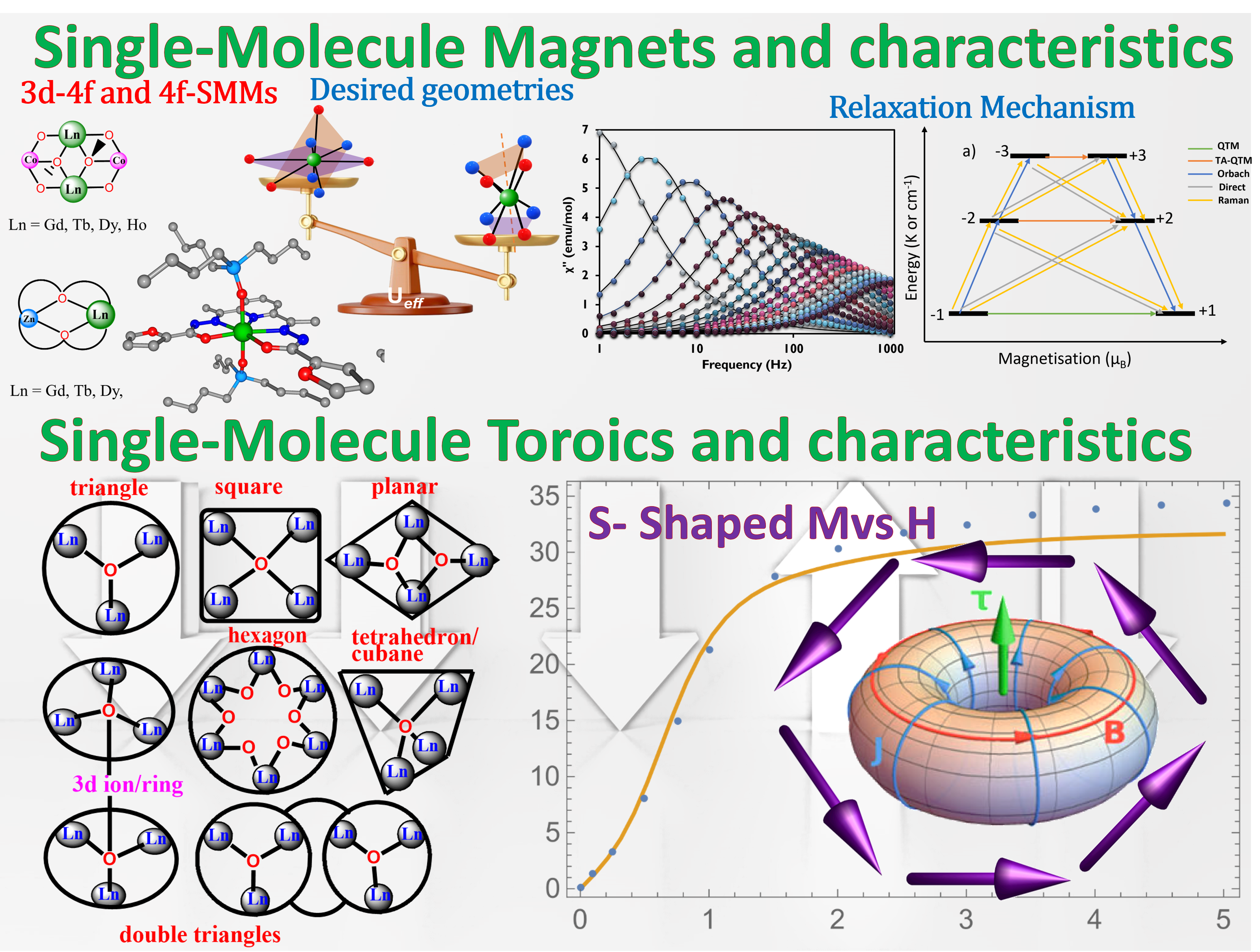
Molecular Magnetism: Our group research work mainly deals with the synthesis and modeling of spin-Hamiltonian parameters in transition metal, lanthanide, and radical-bridged coordination complexes using both experimental and computational tools to understand their molecular magnetic behavior. Certain mononuclear/polynuclear complexes are capable of retaining their magnetization even in the absence of a magnetic field which gives rise to magnetic hysteresis at a molecular level and an ability to act as magnets below their blocking temperature and these molecules are termed Single-Molecule Magnets (SMMs) or Single-Ion Magnets (SIMs). We also focus on Single-Molecule Toroics (SMTs), which are defined as molecules that display a toroidal magnetic state which can potentially be used in multiferroic materials. Both SMMs and SMTs have intriguing potential applications in memory storage devices, quantum computing, and spintronic devices.
We use X-ray diffractometer and SQUID magnetic instrumentation to characterize these magnetic complexes. To further understand the observed magnetic behavior of synthesized molecules, we employ both density functional theory (DFT) and ab initio methods using various quantum mechanics programs.
Heterogeneous catalysis: The main areas of catalysis are focusing on minimizing the environmental impacts while combusting fuels from automobile engines. Our group is searching for the three-way catalyst (TWC) of a car that exploits three reactions which include NO reduction, CO oxidation, and oxidation of unburnt hydrocarbons. We are adopting the computational approach to understand CO and NO adsorption and to intensively seek a suitable metal oxide surface for the investigation of the NO-CO reaction mechanism. We perform slab model calculations by spin-polarized DFT methods using the VASP program.