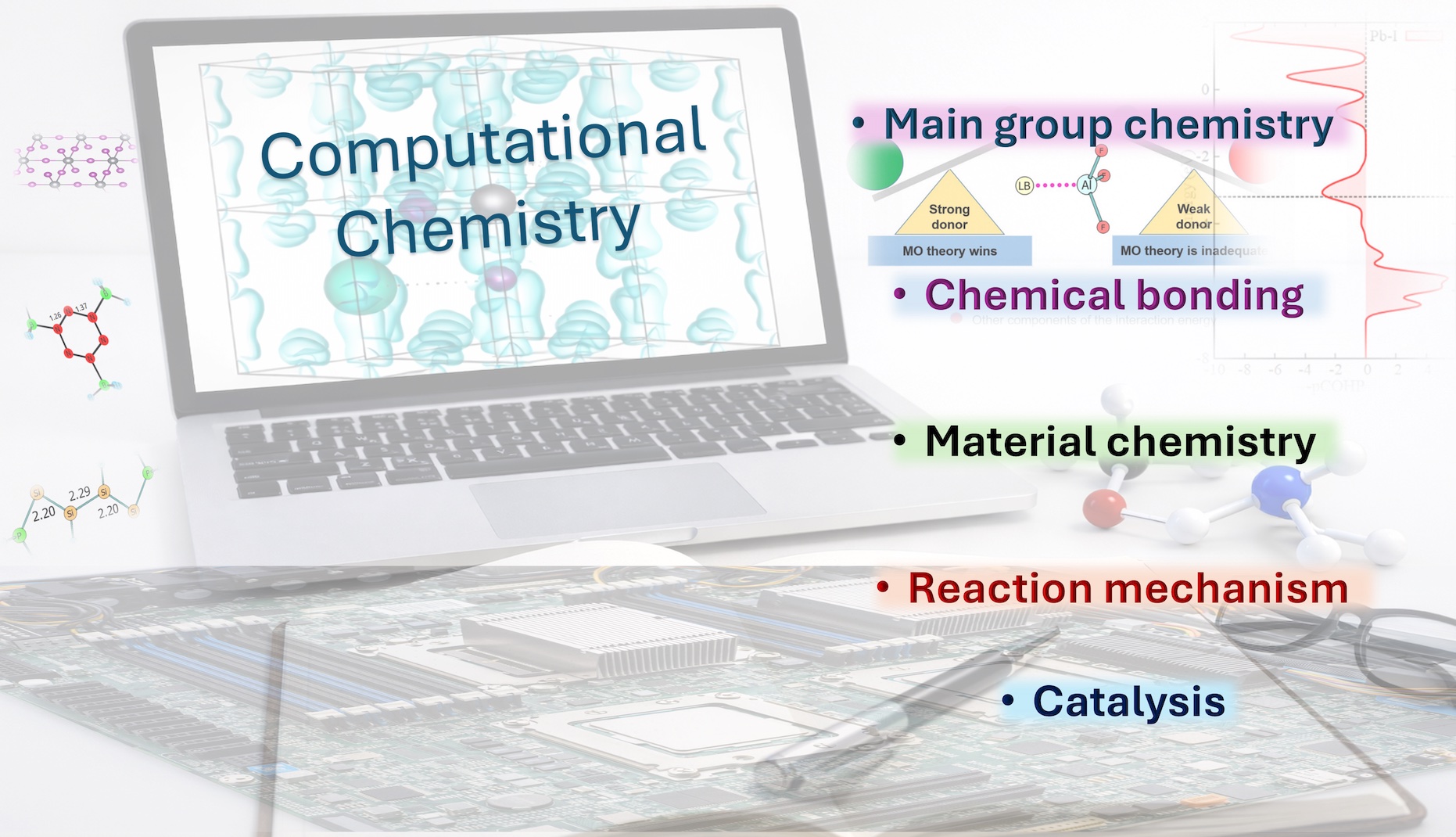
Theoretical and Computational Chemistry
Our research focuses on theoretical and computational chemistry with an emphasis on computational materials chemistry. We employ first-principles simulations and electronic structure methods to understand and design functional materials with technologically relevant properties.
A central theme of our work is phase-change memory (PCM) materials, where we investigate the nature of chemical bonding, phase transition mechanisms, and strategies for designing materials that can enable next-generation in-memory computing technologies. By understanding the atomic-scale origins of switching behavior and stability in these materials, we aim to guide the discovery of improved PCM systems.
We are also interested in addressing key technological challenges in energy materials. In particular, we study the instability of lead-halide perovskites, which remains a major barrier to the commercialization of perovskite-based solar cells. Our research explores the fundamental chemistry behind these stability issues and aims to design new, stable, and less toxic materials that could serve as efficient solar absorbers.
Another important direction of our work is developing a deeper understanding of chemical bonding in materials, using advanced computational approaches to reveal how bonding interactions govern structural stability, electronic properties, and reactivity.
Beyond materials chemistry, our research interests extend to main group chemistry, catalysis, and reaction mechanisms, where computational methods are used to uncover fundamental principles that guide molecular structure and reactivity.